

Regional cooperation is required to ensure sustainable management of the South China Sea's shared fish stocks. But that cooperation will only be effective if is based on sound scientific evidence.
By combining expertise and evidence from across the region, the FSWG provides the scientific foundation so the region can ensure future generations can benefit the South China Sea's fisheries resources.
Regional cooperation is required to ensure sustainable management of the South China Sea’s shared fish stocks. But that cooperation will only be effective if is based on sound scientific evidence.
By combining expertise and evidence from across the region, the FSWG provides the scientific foundation so the region can ensure future generations can benefit the South China Sea’s fisheries resources.
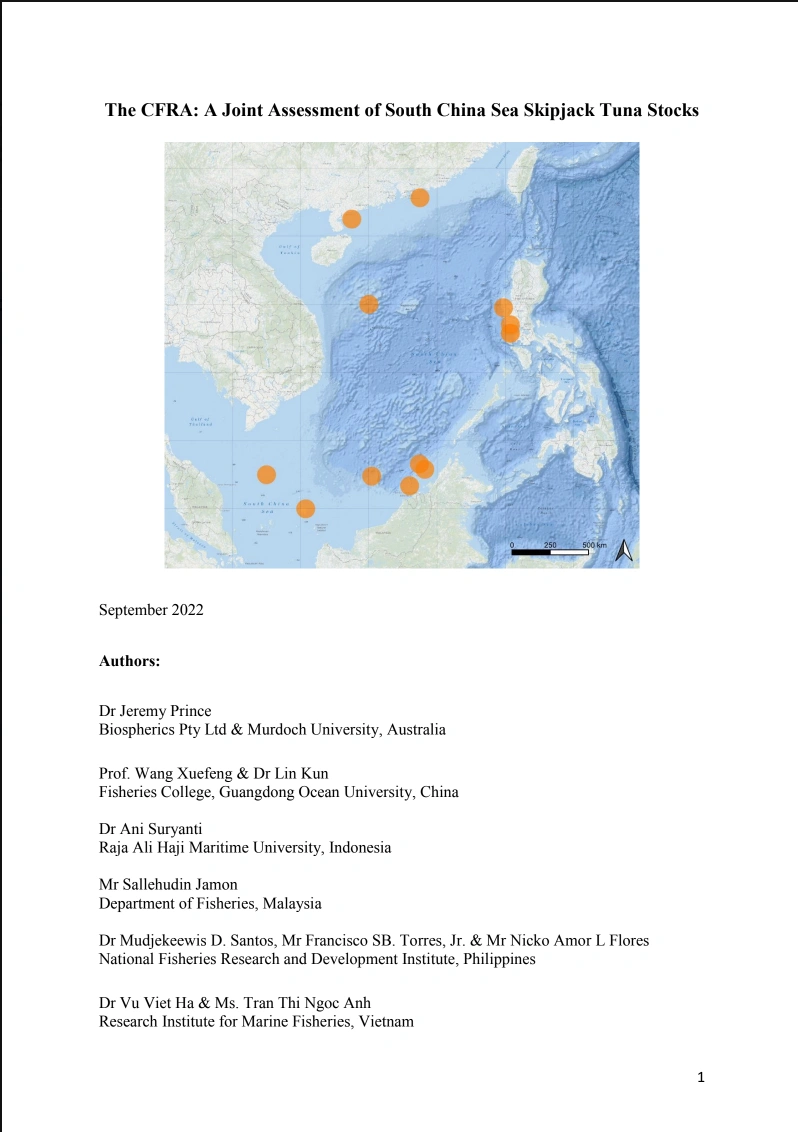
The 1st CFRA assessed the status of Skipjack Tuna (Katsuwonus pelamis) stocks in the South China Sea. We selected Skipjack Tuna because of its economically important, highly migratory, and transboundary nature. Skipjack Tuna is eaten throughout the region, and all the five participating countries had data that they could contribute.
The 1st CFRA process demonstrates that despite the political sensitivities, countries around the region have been able to conduct practical scientific cooperation that supports the sustainable management of shared fish stocks. This study documents a novel approach to conducting basic fisheries studies with the explicit aim of reducing international tensions in a contested region by facilitating and informing international dialogue about resource management.
The findings of the 1st CFRA were publicly launched in 2022 in Manila and Beijing. The Philippine National Security Advisor (NSA) delivered the keynote address to scientists, researchers, diplomats and national security officials from China, Indonesia, Malaysia, the Philippines and Vietnam, along with members of the diplomatic and press corps.

The 2nd Common Fisheries Resource Analysis (CFRA 2) evaluates the status of Little Tuna (Euthynnus affinis) in the South China Sea. Little tuna is an economically important species that the United Nations Convention of the Law of the Sea classifies as a “Highly Migratory Species” that requires cooperative management. Results reveal a north-south divide.
In the south, adults still appear in catches under moderate to heavy pressure, and lowering juvenile catch is key to sustainability. In the north, adults and sub-adults are rare or absent, and later declines in juveniles indicate a local collapse. Because larvae and juveniles drift across jurisdictions, rebuilding stocks in the northern areas is possible if the region reduces the number of juvenile fish caught.


The 3rd CFRA will analyse the status of Mitre Squid (Uroteuthis chinensis) and Indian Ocean Squid (Uroteuthis duvaucelii). These species’ stocks are frequently spread across international boundaries and, therefore, require cooperative management.
Moreover, squid species are considered to be particularly impacted by changing water temperatures. The FSWG’s analysis will provide insight into how climate change affects the South China Sea’s fisheries.